


Key Points:
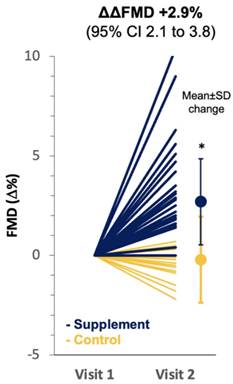
- Daily supplementation improved vascular function after six months, increasing flow-mediated dilation—a measure of how well blood vessels widen.
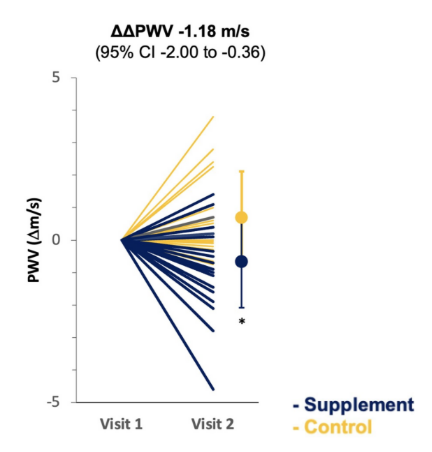
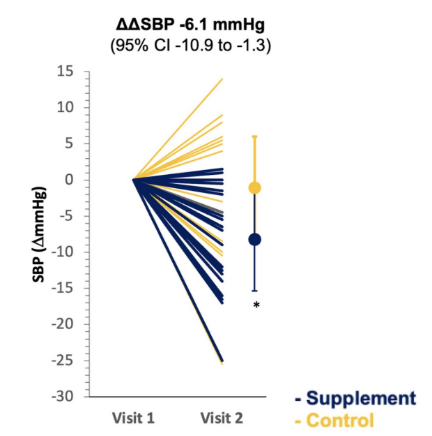
- The supplement reduced arterial stiffness and lowered systolic blood pressure (the pressure of blood against artery walls when the heart pumps blood).
- Cholesterol levels remained unchanged, while estimated 10-year cardiovascular risk declined modestly, primarily because of lower systolic blood pressure.
As published in the European Heart Journal, researchers from the University of Surrey in the UK unveiled results from a six-month human trial, involving adults aged 40 and older, that measured the effects of a multi-ingredient supplement on facets of vascular health. They found that the supplement improved vascular function by increasing flow-mediated dilation, a measure of how well blood vessels widen, by 2.9%. Moreover, the supplement significantly reduced pulse wave velocity, a measure of arterial stiffness, and lowered systolic blood pressure by 6.1 mmHg (comparable to medications prescribed for high blood pressure). While cholesterol levels remained unchanged after six months of supplementation, estimated 10-year cardiovascular risk (an assessment predicting the likelihood of experiencing a heart attack, stroke, or cardiovascular-related death over the next 10 years) modestly declined. These results showed that the multi-component supplement sustained improvements in vascular function in middle-aged and older adults.
Ingredients in the Multi-Component Supplement
For their study, the UK-based researchers chose ingredients in their supplement to target complementary biological processes involved in vascular aging. However, not any single ingredient was predicted to drive benefits to vascular function on its own. Along these lines, their rationale was that a multi-ingredient approach might better address the multiple interacting causes of age-related blood vessel dysfunction. Without going into extensive detail on individual ingredients, the following components were included to target endothelial cells (the cells that regulate blood flow), redox balance (the balance between reactive molecules and antioxidant defenses), inflammatory signaling, metabolic regulation, and vascular tone (the degree to which blood vessels constrict or relax):
| Ingredient | Amount |
| Glycine | 2,000 mg |
| Magnesium malate | 304 mg magnesium and 1,700 mg malate |
| Calcium alpha-ketoglutarate | 1,100 mg and 231 mg calcium |
| Vegan glucosamine sulfate | 1,000 mg |
| Rhodiola rosea root extract | 300 mg |
| L-theanine | 150 mg |
| Vitamin C (ascorbic acid) | 100 mg |
| Hyaluronic acid | 100 mg |
| Fisetin | 100 mg |
| Organic ginger root extract | 100 mg, standardized to 2% gingerols |
| Pterostilbene | 50 mg |
| Lithium aspartate | 20 mg, providing 1 mg lithium |
Preventing Vascular Dysfunction in Mid-Life to Counter Aging
The researchers tested the supplement in otherwise healthy middle-aged and older adults because they hypothesized that preventing age-related vascular dysfunction in this age range can counter vascular aging. Accordingly, they described several age-related changes that can damage endothelial cells, the cells lining blood vessels, and the smooth muscle cells that constrict and dilate blood vessels. These changes are as follows:
- Stress to the cell’s powerhouses (mitochondrial stress) from reactive molecules
- Chronic low-grade inflammation
- Cellular senescence, in which cells enter a persistent state of growth arrest and can emit inflammatory molecules
- Disrupted nutrient sensing and reduced resilience to cellular stress
- Remodeling of the extracellular matrix—the structural material surrounding cells
These age-related changes to endothelial cells and smooth muscle cells can lead to endothelial dysfunction. Endothelial dysfunction contributes to the development and progression of age-related cardiovascular diseases.
The Supplement Improved Blood Vessel Dilation and Stiffness and Modestly Reduced a 10-Year Cardiovascular Risk Assessment
To assess whether the multi-ingredient supplement countered the aforementioned aspects of vascular aging, the researchers designed and implemented a randomized controlled trial. A randomized controlled trial is a study in which participants are assigned by chance to receive either the treatment being tested, in this case the supplement, or a placebo to compare their outcomes over time. Randomized controlled trials help determine whether a treatment causes a measurable benefit and are known among researchers as the gold standard for understanding the causative effects of a treatment.
To assess whether the supplement improved blood vessel function, the researchers measured flow-mediated dilation in their randomized controlled trial. Flow-mediated dilation is the widening of arteries in response to increased blood flow, and measuring it helps to assess how well endothelial cells help arteries relax and expand. With supplementation, the researchers found that flow-mediated dilation significantly increased by 2.9%. This finding shows that the supplement indeed helps arteries relax and expand, an aspect of improved blood vessel function.
Arterial stiffness is both a feature of vascular aging and a contributor to further vascular damage. As arteries lose elasticity, they become less able to cushion the surge of blood with each heartbeat, increasing pressure and mechanical stress throughout the circulatory system.
Thus, to assess the supplement’s effects on arterial stiffness, the researchers used a measurement called pulse-wave velocity—the speed at which a pressure wave travels through the arteries. Pulse-wave velocity is generally lower in healthy arteries because their walls are more elastic: they stretch more easily as the pressure from each heartbeat passes through them. This ability to expand allows the pressure wave to travel more slowly than it does through a stiff artery. Accordingly, pulse-wave velocity can increase in aged, dysfunctional blood vessels. Notably, the supplement significantly reduced pulse-wave velocity, indicating that the supplement reduces arterial stiffness.
High blood pressure can accelerate vascular aging by placing sustained mechanical stress on artery walls and promoting cellular changes that make vessels stiffer, more inflamed, and less able to relax. It is both a contributor to and a consequence of age-related vascular dysfunction. With this in mind, the researchers measured the supplement’s effects on systolic blood pressure, the pressure exerted on artery walls when the heart pumps blood. They found that the supplement significantly reduced systolic blood pressure by an average of 6.1 mmHg, an effect comparable to blood pressure medications.
High cholesterol, particularly the “bad” cholesterol, LDL cholesterol, contributes to processes involved in vascular aging, including endothelial dysfunction and inflammation. With that in mind, the researchers measured the effects of the supplement on cholesterol levels and found no changes. This suggests that any benefits that may come from the supplement to alleviate vascular aging are not related to changes in levels of circulating cholesterol.
To gauge whether the supplement may alleviate vascular aging and reduce an assessment of 10-year cardiovascular risk, the researchers administered a cardiovascular risk assessment to the two groups that received either the supplement or a placebo. The supplement modestly reduced estimated 10-year cardiovascular risk compared with the placebo group, primarily because of lower systolic blood pressure rather than changes in cholesterol. This finding indicates a lower predicted likelihood of heart attack, stroke, or cardiovascular death over the next decade.
“These preliminary findings support further evaluation of multi-component nutritional strategies for maintaining vascular health during mid-life, including studies with mechanistic endpoints and longer-term clinical outcomes,” say the UK-based researchers in their publication.
Promising Results for Multi-Ingredient Supplements Targeting Vascular Aging
This six-month trial provides encouraging evidence that a multi-ingredient nutritional supplement can improve several measures of vascular health in middle-aged and older adults. Compared with the placebo group, supplementation improved the ability of arteries to widen, reduced arterial stiffness, and lowered systolic blood pressure. Together, these findings support further investigation of nutritional approaches to maintaining blood vessel function during aging.
However, improvements in vascular health markers are not the same as demonstrating that a supplement prevents or reverses vascular aging. The modest reduction in estimated 10-year cardiovascular risk was a change in a calculated prediction, driven primarily by lower blood pressure, not an observed reduction in heart attacks, strokes, or cardiovascular deaths. Likewise, the trial did not establish that supplementation slows whole-body aging or extends lifespan.
The study’s size and duration also warrant caution. Although 61 participants were randomized, only 43 completed both study visits, limiting confidence in how broadly the findings apply. Because the researchers tested the complete formulation, the results cannot establish which ingredients produced the benefits or whether combining them was more effective than using individual components. Larger, independently replicated trials with longer follow-up would help clarify the durability of the effects, long-term safety, and whether these improvements translate into fewer cardiovascular events.
Ultimately, the findings represent a promising starting point rather than a proven strategy for preventing vascular aging. They suggest that vascular function remains responsive to intervention in midlife and later life, while leaving an important question unanswered: whether sustained improvements in these markers can deliver lasting protection against age-related cardiovascular disease.
 Comments