


Key Points:
- Octreotide helps older dogs maintain task engagement.
- The drug also helps dogs make faster choices amid distractions.
- Octreotide-treated dogs respond faster in a spatial memory task.
Man’s best friend is not immune to the toll of brain aging. Older dogs can develop canine cognitive dysfunction (CCD), often called dog dementia. The condition shares features with Alzheimer’s disease (AD), including neurodegeneration and difficulties with learning and memory. Yet treatment options remain limited.
In pursuit of treatments that promote health and longevity, scientists are finding that repurposed drugs may be beneficial for older adults. Now, a new study published in Frontiers in Veterinary Science suggests this may hold for older dogs. In the study, researchers found that octreotide, a drug used to treat acromegaly in humans, helped aged beagles respond more quickly and stay engaged during cognitive testing.

Octreotide Helps Older Dogs Maintain Task Engagement
The study enrolled 28 beagles between 7 and 15 years old, all in good general health and experienced with cognitive testing. After baseline assessments, researchers divided the dogs into two groups: one received a single injection of long-acting octreotide, while the other received a placebo.
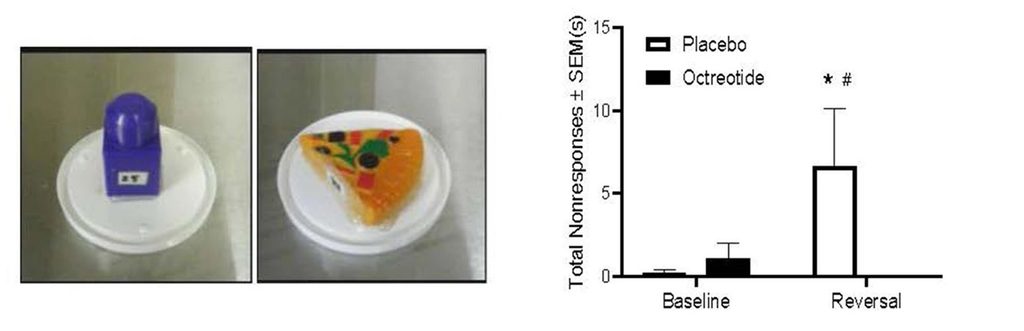
To challenge the dogs’ ability to adapt to changing rules, researchers used two objects—a purple block and a pizza slice. They first identified each dog’s preferred object, then trained each dog to choose it for a food reward. Subsequently, they reversed the rule, and the dogs were only rewarded if they chose the opposite object.
The researchers found that the dogs often failed to make any choice at all. Following the rule change, placebo-treated dogs showed a significant increase in these “non-responses.” However, octreotide-treated dogs did not show a significant increase, suggesting that treatment helped preserve engagement when the task became more challenging.
Octreotide Helps Dogs Make Faster Choices Amid Distractions
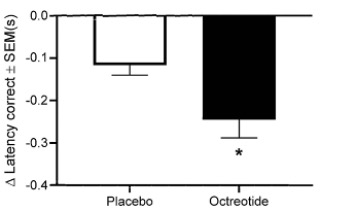
The researchers also tested how quickly the dogs could identify an object among distractions. They presented each dog’s preferred object alongside a distractor object, for which they were not rewarded. As more distractor objects were added, the dogs had to select their preferred object to obtain a reward.
The researchers found that dogs receiving octreotide chose the correct object significantly faster than those receiving placebo. They also showed a greater reduction in the time needed to make the choice relative to their own baseline (before-treatment) performance. This suggests that octreotide helped the dogs select the target more efficiently when competing objects demanded their attention.
Octreotide-Treated Dogs Respond Faster in a Spatial Memory Task
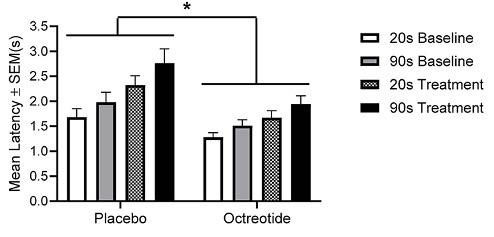
Next, the researchers tested the dogs’ ability to remember a location over a short delay. First, the dogs saw a tray containing a food well covered with a white block. When the dogs removed the white block, a reward was waiting for them in the well. The tray was then removed from view for either 20 or 90 seconds. When it returned, the dogs could see two identical white blocks—one in the original location and another in a new position. To receive the next reward, the dog had to choose the block in the new location, requiring it to remember where the first block had been.
The researchers found that, in general, the dogs took longer to respond after the 90-second delay, reflecting the greater challenge in remembering spatial information. Still, octreotide-treated dogs chose the correct location significantly faster than placebo-treated dogs at both delay lengths. However, they also did better at baseline, and octreotide did not increase the number of correct responses. Still, the results may extend the octreotide-treated dog’s pattern of quicker responses.
Dialing Down Growth Signals Could Support the Aging Brain
Growth requires cells to ramp up the production of proteins and other building materials. But protein production is not flawless, and some proteins emerge faulty or misfolded. While cells can remove unwanted material, growth-promoting signals can suppress autophagy, a major cellular recycling process. Thus, dialing down growth signals may help clear unwanted protein buildup, including amyloid-beta, a protein fragment associated with AD.
Octreotide mimics somatostatin, a hormone that inhibits growth hormone release. Growth hormone normally stimulates the production of insulin-like growth factor 1 (IGF-1), another growth-promoting hormone. By dampening this hormonal pathway, octreotide was shown to lower circulating IGF-1 in this study.
IGF-1 activates pathways that promote growth, including signaling through mTOR, a central regulator of protein production and autophagy. The proposed explanation is that reducing IGF-1 signaling could ease mTOR’s suppression of cellular recycling, helping neurons maintain their components and function more efficiently. The authors also suggest that reduced oxidative and metabolic stress could contribute to the benefits.
A Promising Lead for Aging Pet Dogs
The findings build on earlier research linking reduced growth hormone signaling to healthier brain aging. In a 2001 study, older mice genetically resistant to growth hormone retained memories, while normally aging mice showed declining retention.
A small 2009 study tested octreotide on 19 cognitively healthy older adults and 16 people with AD or mild cognitive impairment. Octreotide improved story recall in the healthy participants, while responses among memory-impaired participants depended on genetic background and baseline cognitive status.
Importantly for pet dogs, a randomized, placebo-controlled study tested octreotide alongside chemotherapy in dogs with cancer. Treatment lowered IGF levels by approximately 43%, with no reported toxicity. That study supports the feasibility of suppressing growth signals in pet dogs.
Together, these studies provide a foundation for testing octreotide in a broader population of aging dogs. The new beagle findings add evidence of improved response speed and task engagement, but not improved cognition. Moreover, it remains unclear whether the changes in response speed translate into better everyday functioning for pets, which is the crucial next question.
 Comments