


Key Points:
- Taurine helps regulate age-related inflammation by suppressing the NLRP3 inflammasome, an inflammation-triggering complex, in immune cells.
- In humans, sustained calorie restriction increases taurine levels in fat tissue and is accompanied by lower inflammation.
- The findings suggest taurine could be a target for addressing inflammaging—chronic, low-grade systemic inflammation that develops as people age.
Sustained, low-grade inflammation (inflammaging) has been identified as a key hallmark of aging. Relatedly, the accumulation of physiological damage with age persistently activates the innate immune system (the body’s first line of immune defense against pathogens and tissue damage), which can lead to inflammaging. Resulting inflammaging can facilitate physiological functional decline and chronic age-related diseases.
In more detail, there are two main branches of the immune system: the innate immune system and the adaptive immune system (which is activated by previous pathogens that it “remembers”). Unlike the specificity-based recognition of pathogens used by the adaptive immune system, the innate immune system relies on certain cells, like macrophages (a type of white blood cell), to recognize “danger signals”, such as environmental pollutants. However, the innate immune system’s mechanism behind recognizing certain danger signals has remained an enigma up to this point.
Now, as published in Cell, scientists from Yale University School of Medicine provide evidence that the compound taurine mediates one way that the innate immune system senses danger signals to cells. Moreover, the researchers showed that supplementing with taurine diminished signs of inflammaging and improved markers of physical function in aged male mice.
“Biology has lots of surprises,” says lead author of the study, Vishwa Deep Dixit, PhD, in a press release. “And the biggest surprise in this study is that taurine is controlling the innate sensing mechanism.”
“Since the innate immune system does not have specific receptors for each and every type of danger signal, this pattern recognition has always been a mystery,” he added.
Calorie Restriction Increases Circulating Taurine
Dixit and colleagues became interested in taurine due to the finding that its levels increased as people restricted their daily intake of calories (a dietary regimen known as calorie restriction) for up to one year. Dixit’s research team also found that moderate calorie restriction leads to lowered inflammation. However, engaging in calorie restriction is not practical for most people, due to the discomfort of hunger. Moreover, it remained unclear whether taurine itself lowered inflammation and, importantly, whether it modulates the immune system.
“We wanted to test whether taurine is just a passenger or a driver of the reduction in inflammatory response caused by caloric restriction,” says Dixit.
Yale Scientists’ Study Shows Taurine Serves as a Checkpoint of Inflammation
The Yale researchers expected that taurine levels may diminish with age. After all, aging is associated with inflammation, and calorie restriction is associated with increased taurine and lowered inflammation. However, this expectation turned out to be false.
Through a comparison of blood serum (a pale-yellow liquid left after blood cells are removed from blood) of young (20- to 40-year-old) and older (60- to 99-year-old) individuals, the researchers found that taurine increased with age. This finding suggested that taurine does not drive aging.
However, the researchers suspected that increased taurine with age may stem from the body’s failed attempt to reduce inflammation. Accordingly, increased taurine levels with age could represent a failed adaptive response to inflammation.
Relatedly, inflammaging is caused, in part, by the activation of a complex of molecules called the NLRP3 inflammasome. When macrophages encounter danger signals, the NLRP3 inflammasome components assemble within macrophages, contributing to inflammation. Furthermore, research shows that lowering overly active NLRP3 extends lifespan in mice and protects against inflammaging-driven physical decline.
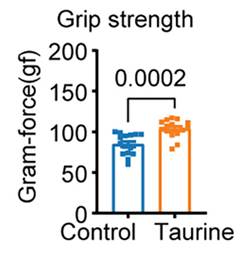
To determine whether taurine plays a role in NLRP-mediated inflammation, the Yale researchers assessed the effects of taurine supplementation on markers of inflammaging as well as physical function in aged mice. They found that, as expected, taurine supplementation doubled taurine levels in the serum and liver and that these increased levels were accompanied by lowered markers of inflammation in the serum and modestly improved blood sugar homeostasis and strength. As blood sugar homeostasis and strength measurements reflect aspects of healthspan, these findings suggest that taurine improves healthspan.
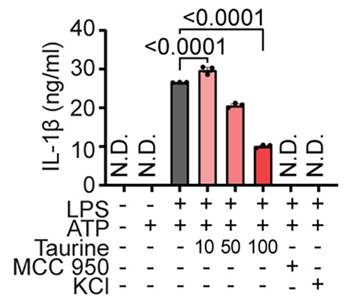
To find out whether taurine mediates the NLRP inflammation pathway to improve healthspan, the scientists challenged macrophages in laboratory dishes with various danger signals, including toxins from bacteria. As the signals took effect, the NLRP3 complexes assembled within macrophages. Interestingly, as the NLRP3 complexes formed, the macrophages released up to 80% of their taurine.
The researchers then wondered whether taurine levels in cells and the release of taurine play a role in allowing macrophages to sense various kinds of danger signals that contribute to the initiation of NLRP3 inflammasome assembly. Sure enough, when taurine levels were restored in cells exposed to danger signals, this stopped the downstream inflammatory responses initiated by the formation of NLRP3 inflammasomes. This finding suggests that, indeed, taurine levels in cells, in part, mediate macrophages’ sensing of danger signals and the subsequent initiation of assembly of the NLRP3 inflammasome.
“Now we know that taurine allows immune sensing and is one of the brakes within the cells that is keeping the inflammasome in check,” says Dixit. “What we have answered is the first step of the puzzle in what causes this very critical innate immune system sensor to be activated.”
“In summary, we demonstrate that the elevation of taurine in aging and CR-induced metabolic stress may be an adaptive mechanism to inhibit inflammaging and restore homeostasis,” say Dixit and colleagues in their publication.
Determining Whether Taurine Supplementation Counters Inflammaging in Humans
Taken together, these findings position taurine as more than a bystander in aging: it appears to act as an internal brake on NLRP3-driven inflammation, helping connect changes within immune cells to their response to danger signals. Rather than supporting a simple model in which taurine declines with age, the study suggests that rising circulating levels may reflect the body’s attempt to counter inflammaging and that further supplementation can improve some measures of health and physical function in aged mice.
However, whether these benefits translate to older adults remains an open question, and the findings do not yet establish taurine supplementation as an effective human anti-aging intervention. The study’s central contribution is therefore both mechanistic and promising: identifying a potential target for reducing chronic inflammation while laying the groundwork for research into whether it can help preserve health later in life. Nevertheless, for those who want to hedge their bet on the possibility that supplementing with taurine counters inflammaging in humans, a month’s supply of taurine supplements can be purchased for anywhere between about $9 and $43 online or at retailers.
 Comments